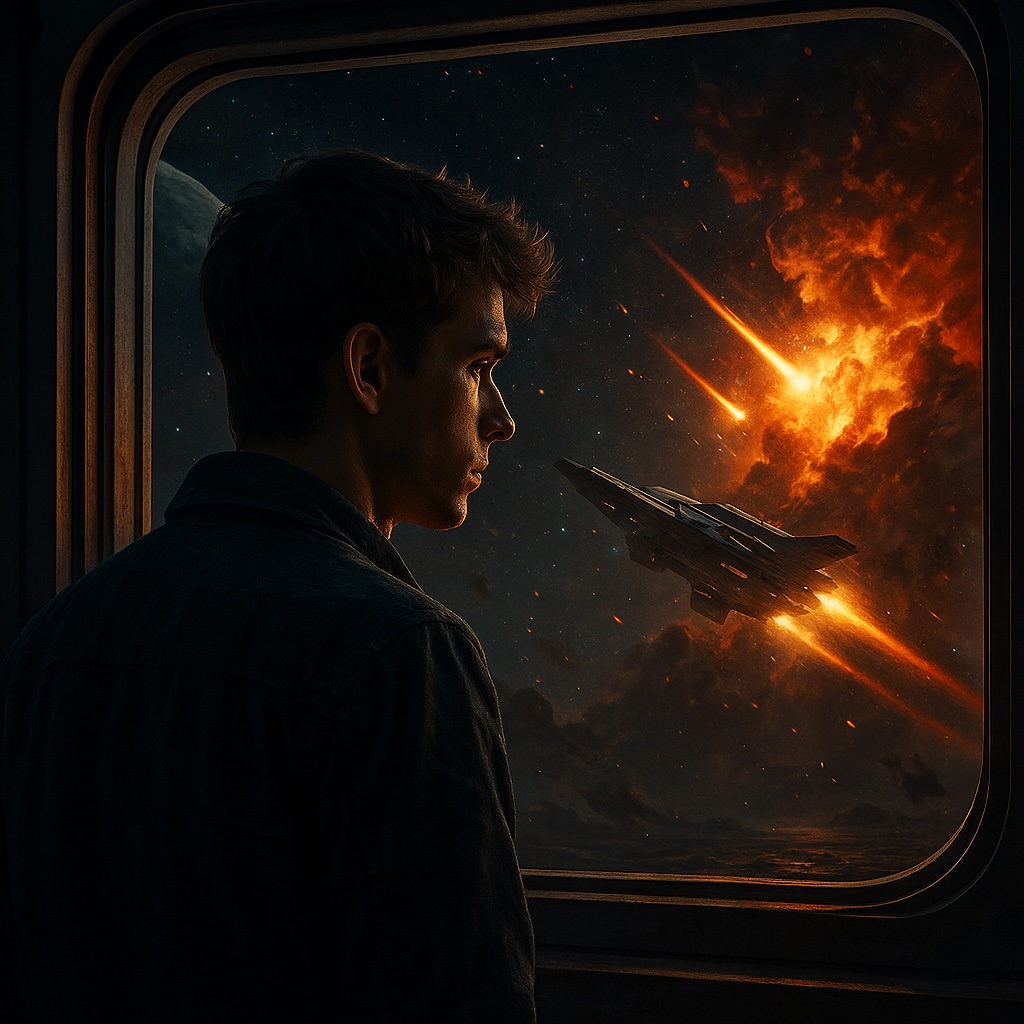
Don’t get me wrong, I love a good space battle. Whether it be in Star Trek, Star Wars, Stargate, BSG or any other great Sci-Fi franchise, the roar of engines, the flash of weapons fire, the adrenaline, It is part of what makes science fiction such a thrill. But for me, the real impact of a story isn’t found in explosions, it’s in what those explosions mean to the characters experiencing them.
That’s why, when I sat down to write Galaxy’s Child, I made a conscious choice, emotional stakes first, spectacle second. Sci-fi gives us endless playgrounds. Whether it’s called faster-than-light travel, warp speed or lightspeed. The possibilities are endless when we consider the exploration (and creation) of distant worlds, alien cultures and technologies But none of that matters if you don’t care about the people caught in the middle of it. And caring doesn’t come from plot twists or action sequences, it comes from character.
Philip Anders is the perfect example. He’s not the loudest voice in the room. He’s not a natural-born leader or a seasoned war hero. He’s a guy who struggles with doubt, loss, guilt, and purpose. And that’s exactly why you root for him. Because when he does take the controls or risk everything for someone else, it means something. Not because it looks cool (though I hope it does), but because we’ve walked the emotional journey that brought him there.
I’ve always admired stories that strike that balance. Star Trek: The Next Generation had plenty of tense moments and high-stakes scenarios, but the episodes that stick with you are the ones that explore Data’s longing to be human, Picard’s trauma after assimilation, or Worf’s struggle between duty and identity. Those are the stories that stay with you long after the final shot fades to black.
In Galaxy’s Child, the stakes aren’t just about saving Earth. They’re about saving yourself. About learning who you are when the pressure mounts. About trusting your instincts when even the data can’t help you. And about how love, loyalty, grief, and hope are as much a part of the journey as any mission plan.
Yes, there are ships. Yes, there are near-impossible breakthroughs and moments of danger. But they only work because they’re grounded in something real, the characters. That’s the kind of story I want to tell. And if you’ve read Galaxy’s Child, I hope that’s the kind of story you’ve felt unfolding.
 David P. Lloyd