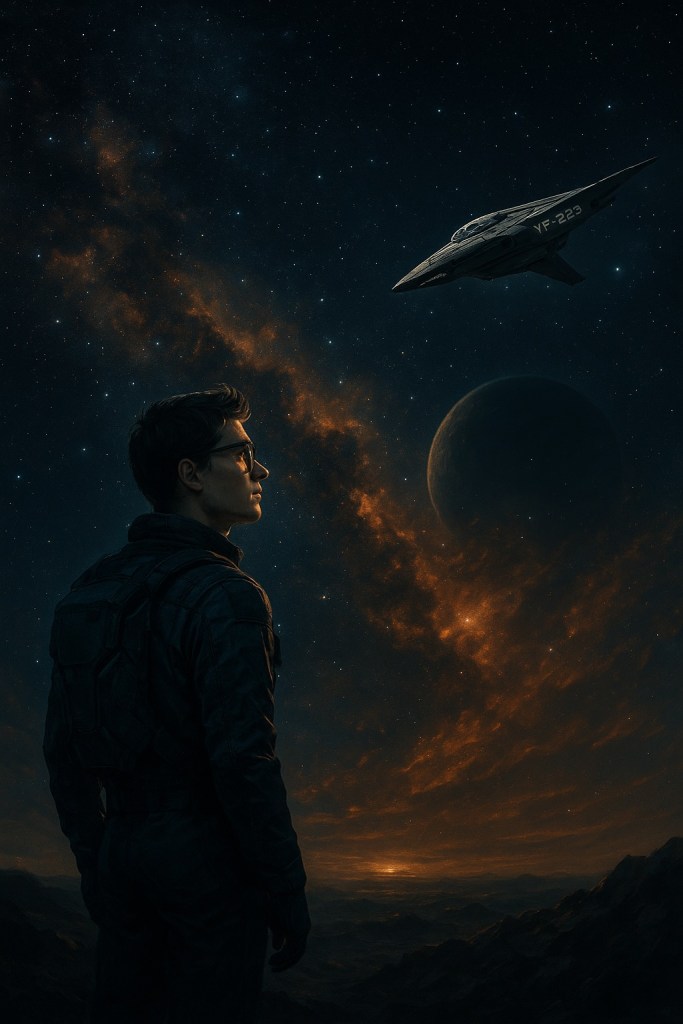
If you walk into a bookstore or scroll through your favorite eBook platform, you’ll notice something: there’s no shortage of science fiction.
Spaceships, aliens, advanced tech, it’s all there. That’s part of what makes sci-fi so endlessly fascinating. But it also means one thing, if you’re going to write sci-fi, you’d better bring something different to the table. That was my mindset from the very beginning.
I didn’t want Galaxy’s Child to be just another space story with shiny gadgets and big explosions (though don’t worry, there are spacecraft and high-stakes moments). I wanted to build something grounded, emotional, and true to character. A story that respects the reader’s intelligence, builds suspense from tension instead of noise, and makes you feel something deeper by the final chapter.
So, what makes it stand out? It respects realism, even when pushing boundaries. The technology in Galaxy’s Child is rooted in real science. The physics of faster-than-light travel, the systems aboard the air and spacecraft, the structure of the moon base, these aren’t fantasy. They’re possibilities. That’s because I believe the best sci-fi doesn’t ask you to suspend disbelief, it invites you to believe just enough.
It’s character-driven, not just plot-driven. Yes, the missions matter. Yes, the stakes are high.
But at the heart of it all is Philip Anders, a flawed, brilliant, relatable human being trying to find his place in a future that’s evolving faster than he is. If you’ve ever felt like the underdog, like you weren’t quite ready but had to rise anyway, his journey might hit home.
It’s emotional before it’s explosive. Don’t get me wrong, there’s tension. There’s risk. There’s loss. But what makes those moments matter is the emotional build-up behind them. You care about what happens because you care about who it happens to.
And here’s where it might surprise you, you don’t have to be a die-hard sci-fi fan to enjoy this book. If you love dramas about internal conflict and transformation, you’ll connect with Philip’s growth. If you enjoy mystery, you’ll appreciate the hidden truths and slowly unraveling threads beneath the surface. If psychological thrillers are your thing, the pressure building inside the program, and inside the characters, will keep you turning the page. Even fans of horror may find themselves gripped by the suspense and creeping dread of what’s unknown in the void.
Galaxy’s Child may live on the sci-fi shelf, but it was built to speak to much more than one kind of reader. It’s about the unknowns we face, out there, and within ourselves. If that sounds like something you’d enjoy, I invite you to take the leap.
Galaxy’s Child is available now in ebook, paperback, and hardcover: 👉 http://www.davidplloyd.com
And as always, I’d love to hear what you took from the story.
 David P. Lloyd