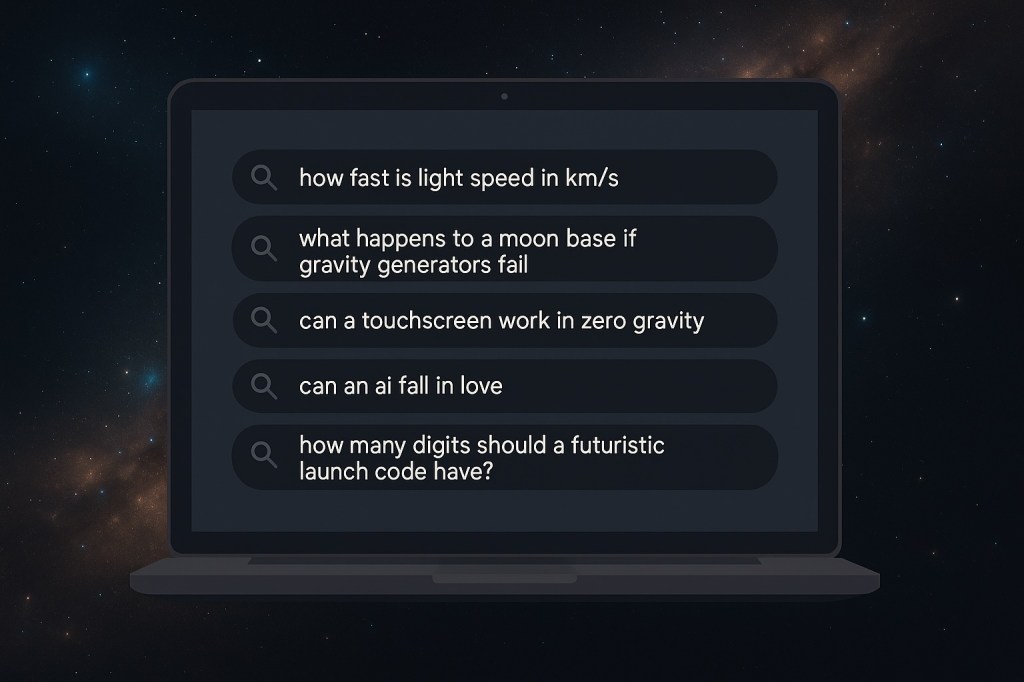
Writing a science fiction novel is a lot like trying to build a spaceship out of duct tape, ambition, and a Wi-Fi connection. You think you’re just crafting a story, but then you look at your browser history and realize that if someone were monitoring your searches (they sure are), they might have questions.
So today, in the spirit of transparency, I present to you:
Things I actually Googled while writing Galaxy’s Child:
🚀 “How fast is light speed in kilometers per second?”
Spoiler: it’s fast. Like, can’t-catch-your-coffee-cup-as-it-floats-away fast.
I must have re-Googled this at least a dozen times just to feel it again.
💻 “Can a touchscreen work in zero gravity?”
Short answer: Yes.
Long answer: Depends on the gloves. And static. And humidity. And whether or not you spilled your space coffee.
🧠 “What does instinct feel like in high-stress situations?”
Because Philip Anders doesn’t always make decisions with logic. Sometimes, he just feels something is wrong. And I needed to capture that, without sounding like he had a sixth sense or a low blood sugar episode.
🛸 “Can an AI fall in love?”
Let’s just say this search took me to some very philosophical (and mildly terrifying) corners of the internet. But it was important, because some questions in Galaxy’s Child aren’t just technical… they’re emotional.
💬 “Is it still a monologue if no one’s listening?”
Yes. Yes it is.
Especially when you’re pacing alone in your house, speaking in character, trying to figure out how Philip would explain FTL mechanics to a general who doesn’t even blink.
🔐 “How many digits should a futuristic launch code have?”
Too few = unsafe.
Too many = the pilot forgets and the ship explodes before launch.
I found a happy medium: just enough numbers and letters to feel futuristic, but not enough to need a calculator. Honestly, that’s something I also got from Star Trek TNG.
The truth is, writing sci-fi isn’t just dreaming up the future, it’s also fact-checking the present, poking holes in ideas, and laughing at yourself for Googling “can synthetic beer cause emotional damage.” After all, I didn’t have a technical team to insert technobabble in a script like they did it on TNG.
Galaxy’s Child may be fiction, but I did everything I could to make it feel grounded, believable, and just a little bit weird, in the best way.
And if my search history ever comes back to haunt me, at least I’ll have a paperback to show for it. 😉
Curious what all that research became?
You can read Galaxy’s Child now in ebook, paperback, or hardcover:
 David P. Lloyd