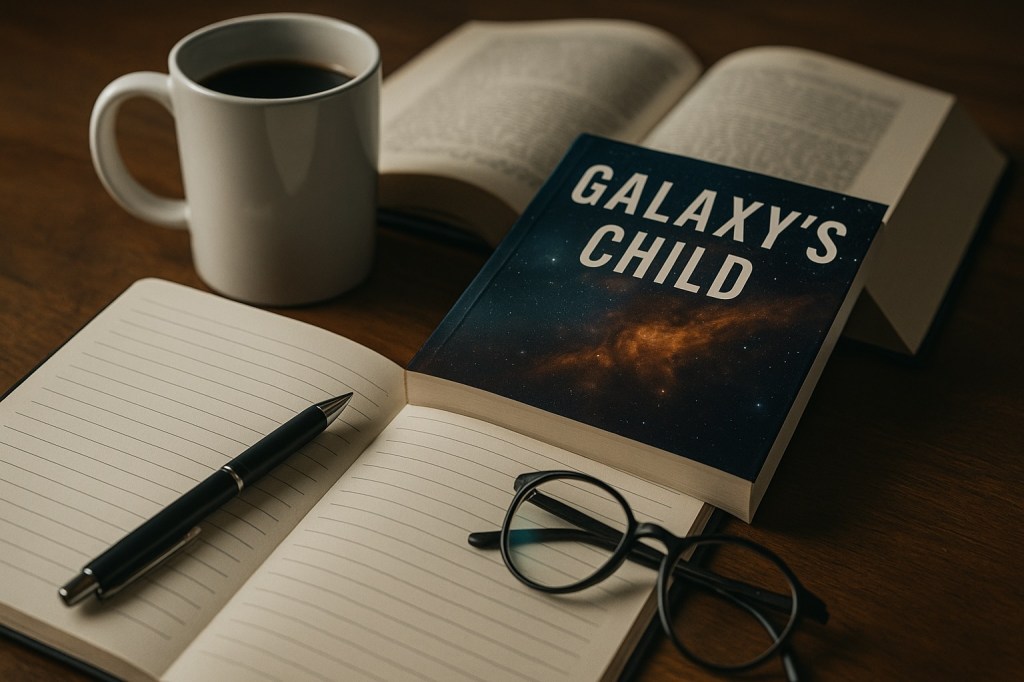
Long before I ever wrote a line of Galaxy’s Child, I was a fan. A wide-eyed kid on a long bus ride to school, watching raindrops slide across the window while imagining alien worlds, epic missions, and starships that could cross the galaxy in seconds. That’s where my voice as a sci-fi writer began, not on the page, but in those daydreams.
Those dreams were shaped by giants. Star Trek: The Next Generation taught me that science fiction could be thoughtful, philosophical, even diplomatic. Stargate SG-1 added the grit and camaraderie I didn’t know I was craving. Battlestar Galactica gave me stakes, sacrifice, and realism. And yes, even the original Transformers sparked something in me: the idea that loyalty and identity could matter just as much as lasers and explosions.
So, when it came time to write Galaxy’s Child, I had a clear sense of what kind of story I wanted to tell. One that was intelligent without being cold, emotional without being melodramatic, and character-driven to its core. But here’s the challenge, how do you make your characters feel real? Especially when you’re the one putting all the words in their mouths.
The answer, for me, came down to one thing, voice.
Each main character in Galaxy’s Child had to sound like themselves, not like a version of me. Philip Anders may share some of my thoughts, doubts, and instincts, but his voice had to reflect someone grappling with responsibility far beyond what I’ve ever faced. Dany Crews had to carry the confidence of a squadron leader, sharp, concise, a little brash when needed. Mike Parks brought calm and authority, with the occasional dry wit. I imagined him as someone who says few words, but they all land. Ava, of course, had to balance mystery with warmth. She couldn’t sound like a twist. She had to feel real. And Dr. Shaw? She was all intellect and observation, but with a spark of hope that made her more than just a voice of science.
When I wrote dialogue, I often read it aloud to hear if it felt right, or if it felt like I was just talking to myself. Sometimes I’d catch a line and think, “Nope. That’s me, not them.” Delete. Rewrite. Try again. It wasn’t about making each character quirky or exaggerated. It was about staying true to their values, their fears, their worldviews. Even when those worldviews clashed, especially then.
As a writer, it’s tempting to make every character say the things you would say in their shoes. But in my experience, the magic happens when you let them surprise you. The characters of Galaxy’s Child don’t all think like me. That’s what makes them feel alive. And if you ever find yourself reading a line and thinking, “That sounds like someone I know… Good. That means it’s working.
 David P. Lloyd