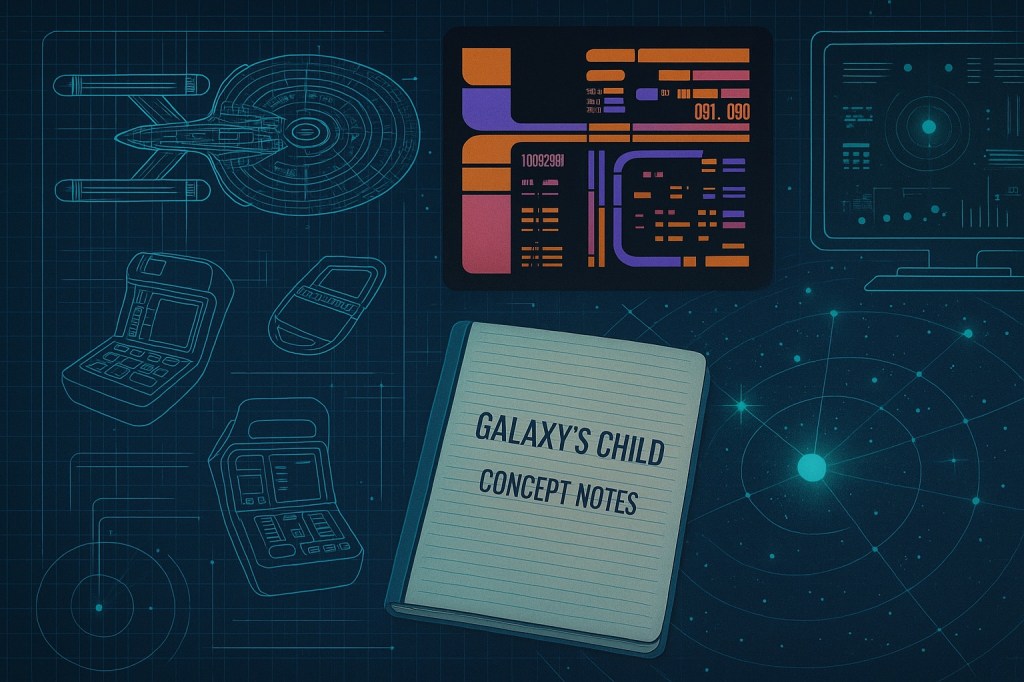
When people talk about the success of Star Trek: The Next Generation, they usually mention the cast, the writing, or the vision of Gene Roddenberry, and all of those deserve praise. But today, I want to shine a light on the people who made TNG feel real, the support and research staff behind the scenes.
Names like Michael Okuda, Rick Sternbach, Herman Zimmerman, Michael Westmore, Richard James, and Michael Moore may not be household names outside the fandom, but their work shaped how Star Trek looked, sounded, and, most importantly, made sense. From LCARS interface graphics to believable starship interiors and scientifically grounded alien makeup, these specialists gave the show a cohesive, credible world that felt not only futuristic, but possible.
There are a lot of moving parts in a successful science-fiction story, but in my opinion, and I’ve said this before, one of the most important is that sci-fi be grounded in science-fact. Sure, there’s room for imagination (there has to be), but the best science fiction respects its audience’s intelligence. And fans of this genre are some of the most observant, sharp-minded, and detail-oriented people out there. They remember inconsistencies. They rewatch episodes. They care.
One of my biggest disappointments in recent Star Trek came during the 2009 reboot movie. Chekov, brilliantly reinvented by the late Anton Yelchin, announces that it will take “minutes” to reach Vulcan just after leaving Earth’s space dock. Minutes? That made no sense to me. Anyone who watched Star Trek: Enterprise knows the NX-01 took four days to reach Vulcan, and that was at warp 5.
Now, I’m not going to get into the math of it. That’s not what this post is about. My point is, where was the fact-checking? Where was the Star Trek memory? Did no one on the writing team ask, “Wait, how long should this actually take?”
In contrast, TNG had that safety net, a team of experts who protected the internal logic of the show. And while I never had access to a team like that for Galaxy’s Child, I did have years of experience rewatching those episodes. I paid attention. I remembered. And now, I have something those creators never had, AI research tools to help me dig deeper, cross-check ideas, and tighten the edges of my fictional universe.
Because here’s the thing:
👉 If the science doesn’t hold up, the story falls apart.
👉 If it’s not believable, it’s not compelling.
So while I might be a one-man team behind Galaxy’s Child, I owe a lot to those who paved the way, not just on screen, but in the background. The unsung architects of starships and stories.
And to the fans who notice the little things, this one’s for you. 🖖
 David P. Lloyd