(And Why It’s Not the Wormhole You’re Thinking Of)
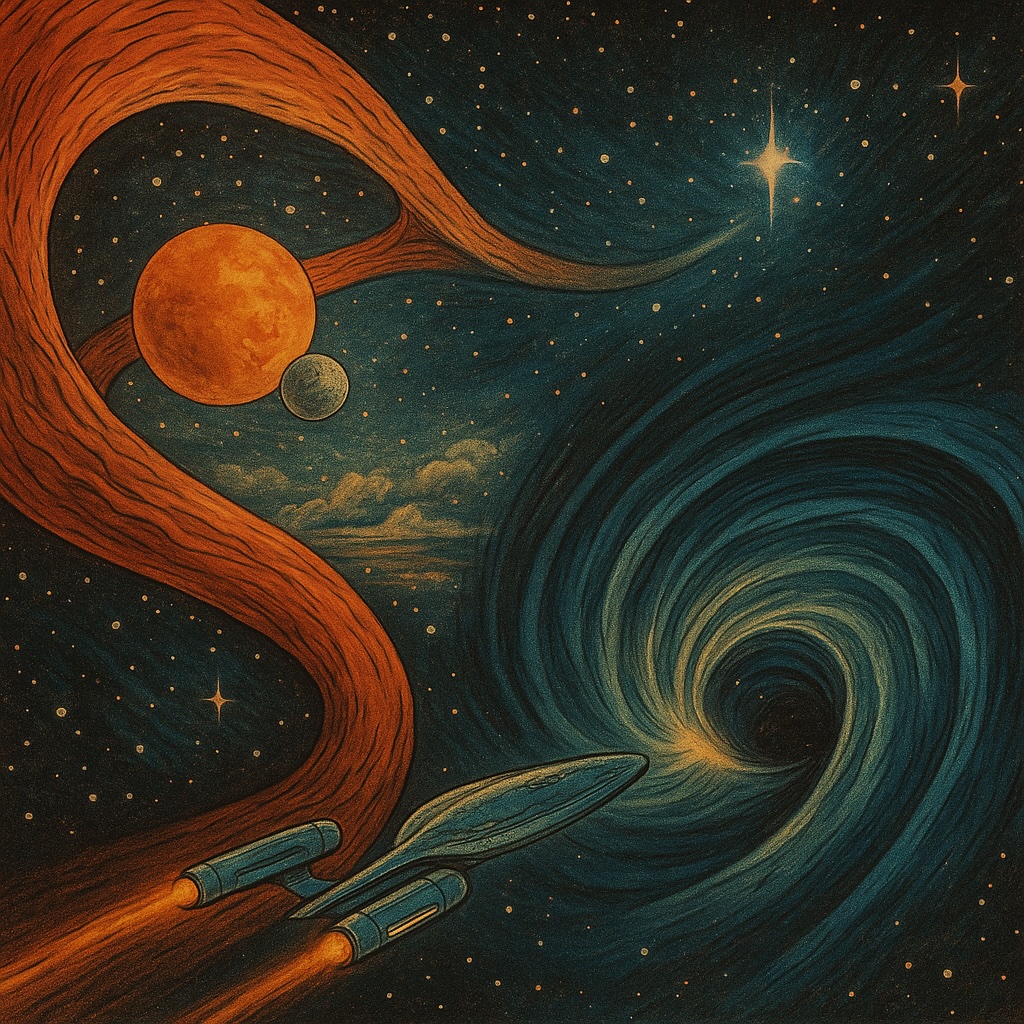
Every so often, a headline makes the rounds that sounds like it belongs in a science fiction novel. Recently, astronomers announced the discovery of what they called a cosmic tunnel, a plasma structure stretching across interstellar space that actually connects our solar system to neighboring regions.
For anyone who grew up on Star Trek or Stargate, it might sound like they’ve just found a wormhole in our backyard. But that’s not what this is.
A Tunnel, not a Shortcut
The cosmic tunnel is made of hot, low-density plasma, the remnants of ancient supernovae shaping a filament that extends thousands of light years. It’s real, it’s vast, and it changes how we understand our galactic neighborhood.
But it’s not a portal. It won’t fling you across the galaxy. It’s a naturally occurring channel of energy, not a shortcut through space-time. And that’s where the distinction between science fact and science fiction becomes important.
Wormholes: The Sci-Fi Shortcut
In fiction, a wormhole is the ultimate travel hack. It is a tunnel through space-time that lets you skip the long trip between stars.
Think of the Stargate system, folding vast distances into a single step. Or the Bajoran Wormhole in Deep Space Nine, turning a backwater sector into the most strategic point in the galaxy Or the countless episodes across the Star Trek franchise where wormholes provided both opportunity and danger.
These wormholes make for incredible storytelling because they raise questions of exploration, strategy, and even morality. But they’re still, for now, fiction.
Wormholes in Real Physics
That said, wormholes do have a foundation in science. Einstein and Rosen first proposed them as “bridges” in spacetime. They could be hypothetical tunnels that could link two distant points in the universe.
The math works, but the engineering doesn’t. To stay open, a wormhole would require exotic matter with negative energy density, something that has never been observed. So, while physics allows for the possibility, we’ve yet to see any evidence they exist.
Science Fact vs. Science Fiction
And here’s the beauty of it, science and science fiction feed each other. Scientists study cosmic tunnels of plasma and map the interstellar medium because they want to understand our place in the galaxy. Science fiction writers imagine wormholes because they want to understand what it would mean if we could step beyond our limitations.
Both are acts of curiosity. Both make the universe feel bigger.
And in Galaxy’s Child?
Now the big question: will you find wormholes or alternate passages through space in Galaxy’s Child?
Let’s just say… you’ll have to read to find out. 😉
 David P. Lloyd