(And Why My Story Revolves Around the FTL Drive)
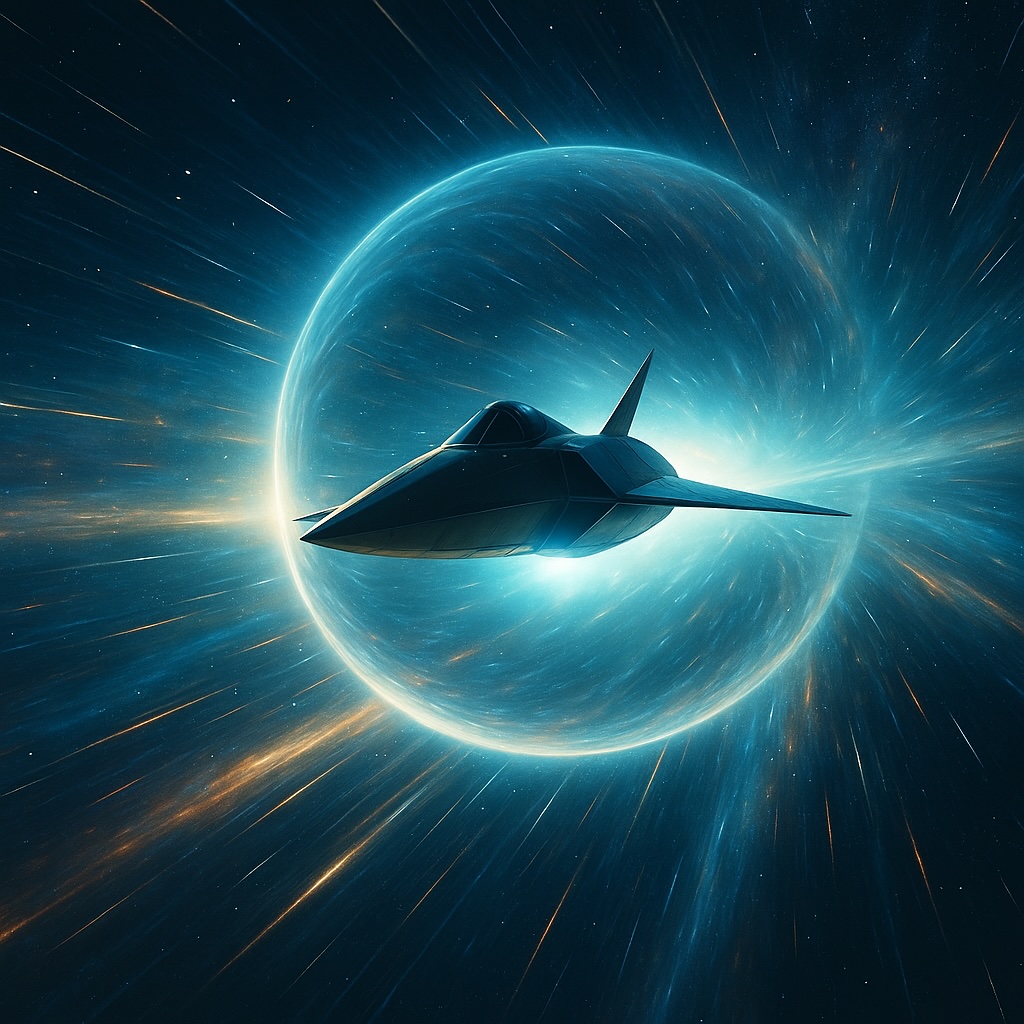
For as long as science fiction has existed, writers have wrestled with the same challenge, how do you get your characters from one star system to another without making the story last thousands of years? The answer has always been faster-than-light travel.
Sci-Fi Inspirations
In Star Trek, it was the warp drive, a clever narrative device built on the idea of bending space itself. In Battlestar Galactica, it was the FTL jump, an instantaneous leap across the cosmos.
When I began writing Galaxy’s Child, I wanted something that felt like it belonged in the same family but wasn’t tied too directly to either franchise. That’s why I settled on the term FTL drive. It’s a bridge between the concepts of “warp” and “jump,” grounded in science but flexible enough to serve the needs of my story.
But my fascination didn’t start with television. It goes back to Isaac Asimov. Asimov’s novels gave us hyperspace lanes and galactic empires, but it was his essays and science books that really struck me. He didn’t just imagine these ideas, he explained the theories behind them. Reading him was like peeking behind the curtain and realizing that the best science fiction is built on seeds of science fact.
Warp Theory Today
For decades, warp drives have stayed in the realm of speculation. Miguel Alcubierre’s famous model in the 1990s showed that, mathematically, a warp bubble could contract space ahead of a ship and expand it behind. The problem was, it required negative energy, a form of exotic matter we’ve never observed but regularly heard about in Star Trek (antimatter). That seemed to shut the door on warp physics.
Until recently.
A new research paper has proposed a warp-drive model that doesn’t rely on exotic matter. The Applied Physics group (APL) has developed a theoretical subluminal design, meaning it stays below light speed using ordinary matter and a “shift vector” similar to those in Alcubierre’s equations. For the first time, a warp concept satisfies known energy conditions numerically.
Another research paper published this August has proposed the first fully physical warp-drive model, one that could, in principle, work using well-understood physics and without relying on exotic matter.
It’s still far from practical. The energy requirements are enormous. The engineering challenges are staggering. But the point is, we’re moving from warp theory toward warp fact.
Why My Story Revolves Around the FTL Drive
This is why I chose to make the FTL drive central to Galaxy’s Child. It isn’t just a convenient plot device. It’s the frontier, the razor’s edge where science fiction and science fact overlap. It’s where imagination pushes science forward, and science, in turn, inspires new stories.
The Big Question
So, does Philip Anders really achieve faster-than-light velocity in this first novel of the trilogy? Well, let’s just say… you’ll have to read the book to find out. 😉
 David P. Lloyd