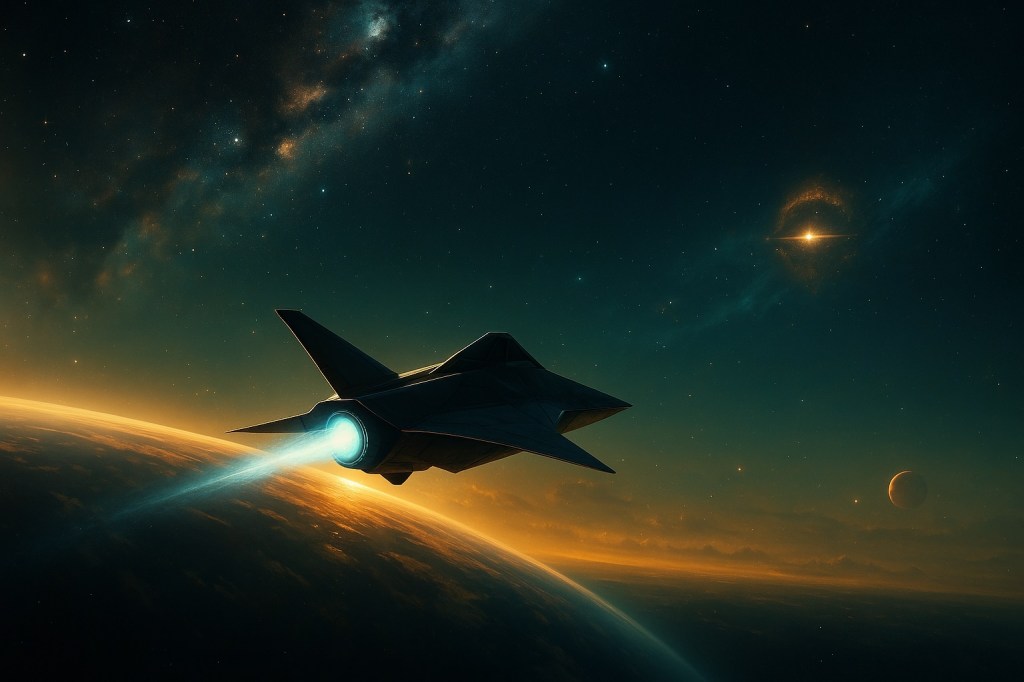
Since the dawn of the space age, we’ve been obsessed with ships that can take us beyond the cradle of Earth.
The Apollo capsules, fragile but daring, carried humans farther than anyone had gone before. Artemis is preparing to continue that legacy, this time with an eye on Mars and beyond. In science fiction, the ships grew larger and more imaginative — the Enterprise as a symbol of optimism, the Millennium Falcon as a symbol of rebellion, the Battlestar Galactica as a symbol of survival.
In my own story, my hope is that the YF-223 carries that same torch. A sleek experimental craft, yes, but also a symbol of human ambition. A reminder that we’ve always dreamed of building something that could take us further.
But here’s the question: what exactly are we sailing toward?
The Other Side of Exploration
For all our fascination with spacecraft, the destination is often more mysterious than the ship itself. Science fiction has always asked the same question, what happens when we finally meet someone out there?
Star Trek envisioned it as the ultimate hope, a galaxy filled with allies and adversaries, but always with the chance to learn. Battlestar Galactica painted it darker, first contact as betrayal, as survival against the very beings we created. And in modern folklore, alien abduction stories blur the line between imagination and fear, with ordinary people describing extraordinary encounters.
Whether in fiction or in late-night radio confessions, first contact is never simple.
Question is, do We Really Want It?
It’s easy to say “yes.” Who wouldn’t want proof we’re not alone? The science, the philosophy, the sheer wonder of it would be undeniable.
But the truth is, we don’t know what it would mean. Would it unify us or divide us? Would it be peaceful or catastrophic? Would we be the explorers… or the discovered?
And maybe that’s why the question endures. It’s not just about aliens. It’s about us. About what kind of species we’ll be when the moment finally comes.
Let me tell you how ow it shaped Galaxy’s Child.
In Galaxy’s Child, spacecraft and first contact are inseparable. The YF-223 isn’t just a vehicle, it’s the spark that propels Philip Anders into a galaxy of secrets. And Ava isn’t just a mystery, she’s the embodiment of what it means to face the unknown and ask: can we trust what’s in front of us?
The story doesn’t offer easy answers. Because neither does reality. So we keep building our ships. We keep looking at the stars. And we keep asking ourselves, do we really want first contact? Philip Anders doesn’t get to answer that question in theory. He had to live it.
And maybe one day, so will we.
 David P. Lloyd