Life, Light, and the Long Road to the Stars
Every few months, NASA drops another headline that sounds straight out of science fiction, signs of life, hints of oceans, traces of strange chemistry light-years away.
The most recent findings from the James Webb Space Telescope once again stirred that age-old question, are we alone? Scientists detected intriguing gases in the atmospheres of distant exoplanets, possible biosignatures that could point to life. They’re faint, delicate fingerprints of chemistry unlike anything we’ve seen before, swirling in the thin skies of worlds we’ll probably never visit, at least, not yet.
Every time NASA releases a new image or data set, I can’t help but imagine what it would be like to stand there, to breathe that alien air, to look up at a sun that isn’t our own. And then reality sets in.
Those worlds are incredibly far away.
The Distance Problem:
Proxima Centauri b, the nearest potentially habitable planet, sits more than four light-years from Earth. That’s roughly 40 trillion kilometers, or about 75,000 years of travel using our fastest spacecraft. That’s longer than all of recorded human history. Longer than the rise and fall of every civilization we’ve ever known.
For all our achievements, for all our telescopes and rovers and brave astronauts, we remain bound to this small blue world by the simple fact of physics: we’re slow. Our rockets burn bright, but they’re nowhere near fast enough to cross the ocean of space that separates us from those other shores. And that’s where imagination, and theory, begin to blur.
The Science of Speed:
In recent years, researchers have made fascinating progress on something that used to live only in science fiction, the warp drive.
At the Applied Physics Laboratory, scientists have proposed what they call a subluminal warp bubble, which is a model that doesn’t rely on “exotic” matter or impossible negative energy. Instead, it reshapes space-time in a way that’s mathematically consistent with Einstein’s relativity, allowing for a kind of bubble of motion that could, theoretically, move faster than light without breaking the rules of physics. For now, it’s only math. But it’s math that works, and that’s a first.
Of course, math isn’t a starship. Engineering a warp drive remains far beyond our reach. We can bend the numbers, but not yet space itself. Still, there’s something poetic about it. Even when we can’t go, we still imagine how we might.
Science Fiction and the Dream of Distance:
Science fiction has always carried that hope, and that impatience. From Star Trek’s warp engines to Interstellar’s wormholes, storytellers have given us glimpses of how we might one day slip the leash of light-speed. It’s never just about travel, it’s about wonder, curiosity and what happens when we finally make it to those distant worlds we’ve only seen through telescopes.
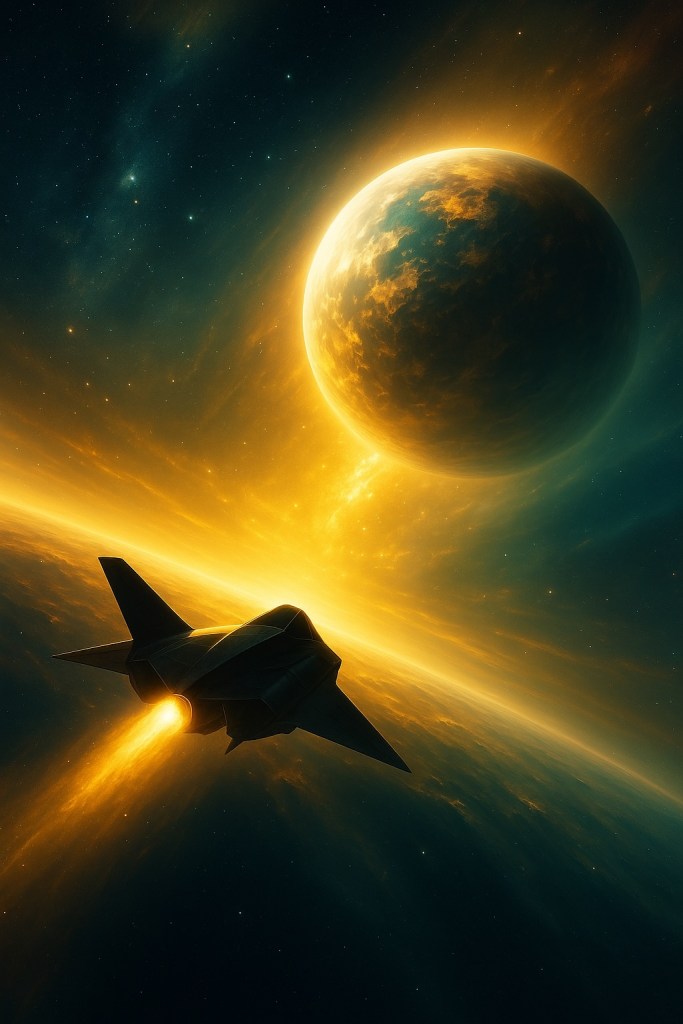
In Galaxy’s Child, the YF-223 represents that dream. A ship that dares to test the boundaries of speed and physics, driven by the same questions scientists are asking today: what if we could go faster? what if we could reach them? But as Philip Anders learns, speed isn’t everything. Sometimes, what waits at the other end of the journey is far more complex than we imagine.
The Hope That Drives Us:
Maybe we’ll find proof of life long before we ever reach it. Maybe by the time we do, we’ll have become something entirely new. What matters most is that we keep looking, that we keep trying to bridge the impossible distance between what we know and what we dream. Philip Anders may live centuries from now, but his journey started here, with the same spark that drives every scientist, every dreamer and every story, the need to know what’s out there.
 David P. Lloyd